Before You Pack the Pills: Navigating Airports, Highways, and State Lines With Your Anxiety Medication
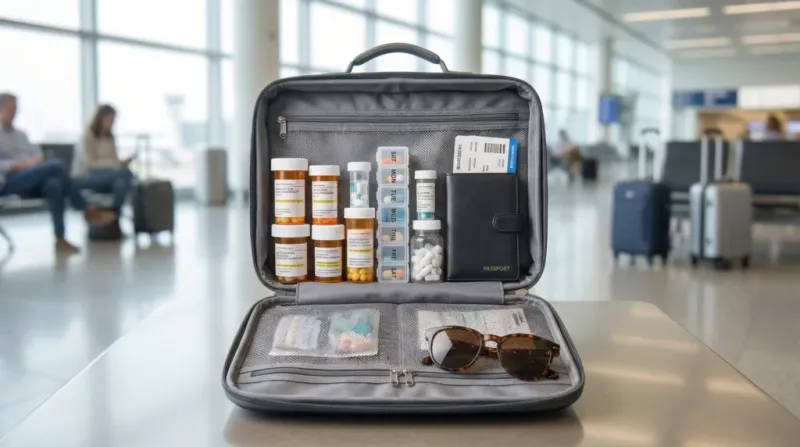
Photo: traveler packing prescription pill bottles suitcase airport, via www.dailydreamtravel.com
For millions of Americans managing an anxiety disorder, a well-planned trip can feel like a test of everything the treatment plan has built. Between airport security, packed itineraries, and unfamiliar surroundings, travel introduces exactly the kinds of stressors that medication is meant to soften. Yet many travelers leave home without thinking through the practical questions: Can I bring my pills through TSA? What happens to my dosing schedule when I cross three time zones? And why did a friend once say her anxiety prescription caused trouble in another state?
Answering those questions before departure can make the difference between a restorative trip and a stressful one.
Getting Through Airport Security With Confidence
The Transportation Security Administration (TSA) does not prohibit prescription medications in carry-on bags — in fact, travelers are strongly encouraged to keep them there rather than in checked luggage, where temperature swings and lost-bag risks come into play. Pills, capsules, and liquid medications are all permitted, with a few practical notes.
Solid medications do not need to be in original containers under federal TSA rules, but keeping them in the labeled pharmacy bottle is the simplest way to avoid questions and to prove ownership. Liquid medications exceeding the standard 3.4-ounce limit are generally allowed in reasonable quantities for the flight, but they must be declared to security officers at the checkpoint for separate screening.
Travelers enrolled in TSA PreCheck should note that medications still need to be presented as usual; trusted traveler status does not exempt prescriptions from screening procedures. For anyone uncomfortable having medications handled publicly, a passenger may request that screening occur privately.
Time Zones and the Timing of Doses
Once- or twice-daily dosing schedules can become surprisingly confusing when a trip spans multiple time zones. The key principle, pharmacists generally agree, is consistency over precision: most anxiety medications tolerate a shift of an hour or so per day far better than a skipped dose or a double dose.
A common approach is to transition gradually — moving the dose roughly one hour earlier or later each day until it aligns with the destination's local time. Travelers taking medications with narrow timing windows or significant withdrawal risk, such as certain benzodiazepines or venlafaxine, should consult their prescriber or pharmacist before adjusting anything. A brief phone call before the trip is far easier than managing discontinuation symptoms in a hotel room.
Setting phone alarms in the destination's time zone, and packing doses in a small pill organizer labeled by day, helps prevent the most common travel error: accidentally doubling up because of uncertainty about whether a dose was taken.
Why State Lines Can Matter
Most people assume a valid prescription works everywhere in the United States. Often it does — but not always. States set their own rules for controlled substances, and several anxiety medications fall into that category. Benzodiazepines such as alprazolam, lorazepam, and clonazepam are Schedule IV drugs, and a handful of states impose additional requirements on quantities dispensed, refills, or even transport.
Georgia, for example, has historically restricted how much of certain Schedule IV medications can be dispensed at once. Travelers driving through multiple states should also be aware that law enforcement may question loose pills found in a vehicle, which is one more reason to carry medications in their original labeled containers.
Another wrinkle: prescriptions themselves do not always transfer. A pharmacy in another state may not be able to fill remaining refills written by an out-of-state prescriber without verification, and controlled substance prescriptions face additional hurdles. Anyone planning an extended stay should ask their prescriber about options before leaving.
A Pre-Travel Checklist for Medication Safety
A few minutes of preparation covers most contingencies:
- Carry more than you need. Pack at least several extra days of medication in case of delays.
- Keep documentation handy. A printed prescription list or a pharmacy printout adds credibility if questions arise.
- Split your supply. Keep some medication in a carry-on and some with a travel companion or second bag.
- Know your pharmacy chain. Many national pharmacy chains can access prescription records across state lines, simplifying emergency refills.
- Save prescriber contact information. A secure patient portal message or phone number should be stored on your phone, not just on paper at home.
When Medication Is Lost Far From Home
Even careful travelers occasionally lose a bag, leave a bottle in a hotel room, or have medication stolen. The recovery path is straightforward if you act quickly.
First, contact a local pharmacy. Many chain pharmacies can view prescription histories nationally and may be able to fill an emergency supply, though controlled substances may require prescriber authorization. Second, reach out to the prescribing clinician, who can often send a new prescription electronically to a pharmacy near your location. Telehealth services have made this process faster than it once was, particularly for non-controlled medications such as hydroxyzine or buspirone. Finally, a police report can help in cases of theft, particularly for controlled substances, where a documented loss protects both the patient and the prescriber.
The Calm Way Forward
Anxiety management does not pause at the departure gate, and neither should preparation. With medications in original containers, a dosing plan adjusted for time zones, awareness of state-specific rules, and a recovery strategy for the worst case, travelers can protect the progress they have made — and arrive at their destination with one less thing to worry about. For personalized guidance, a quick conversation with a pharmacist or prescriber before any trip remains the most reliable step of all.